Stitching the Word: Narrative Quilting and Fiber Arts Workshops for Church Events
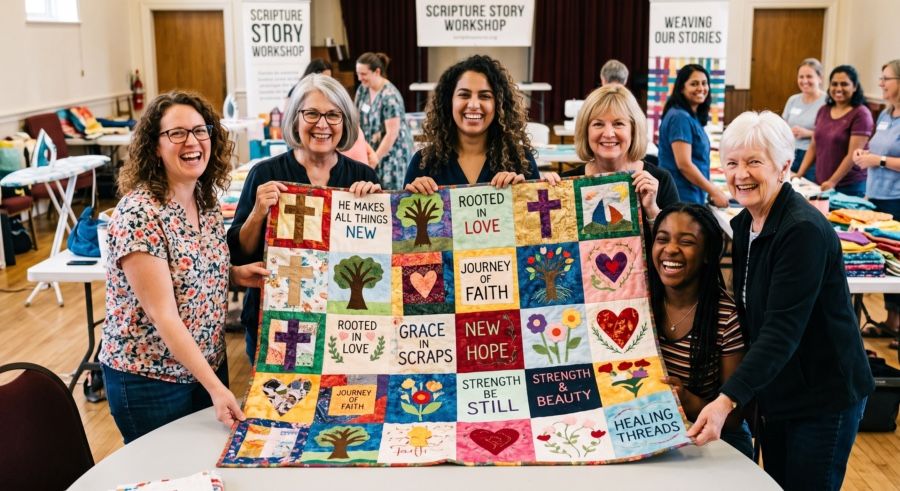
For centuries, women’s ministries have gathered around quilting frames, their hands moving in rhythm while their hearts shared life’s burdens. Today, a fresh movement is breathing new life into this ancient tradition. Churches across the country are moving beyond standard pattern following to embrace narrative quilting and fiber arts workshops — turning scraps of fabric into deeply personal visual parables of faith, redemption, and community.
Whether planned as a cornerstone activity for a fall women’s retreat or as a multi week small group series, these workshops offer an intentional, hands on space where participants can slow down, reflect on scripture, and piece together their own spiritual testimonies.
What is Narrative Quilting?
Unlike traditional quilting, which relies on strict, repeating geometric blocks, narrative quilting (often called story quilting) uses raw edge appliqué, embroidery, fabric paint, and found textiles to tell a specific story.
In a church setting, this approach strips away the intimidation factor. Participants do not need master level precision or perfect quarter inch seams. Instead, the focus is on raw expression. A square might feature a silhouette of a tree representing deep roots in scripture, or scraps from a loved one’s old shirt pieced together to symbolize a season of grief and comfort.
The Theology of the Scrap: Narrative quilting acts as a beautiful visual metaphor for redemption. It mirrors the way God takes the broken, mismatched, and discarded scraps of our lives and pieces them together into a masterpiece of resurrection and new life.
Structural Ideas for Church Workshops
To make a workshop successful, it needs a clear framework that balances instruction with spiritual reflection. Here are three format models trending in modern ministry:
The Legacy Quilt (Collaborative)
- The Concept: Every woman in the ministry creates a single narrative block based on a unified theme (such as "The Names of Jesus" or "Our Autumn of Gratitude").
- The Execution: During the workshop, women design their individual squares using fabric fusion or raw edge stitching. The blocks are later pieced together by a team into a large tapestry or wall hanging to be displayed in the church sanctuary or dedicated during a service.
The "Threads in Faith" Prayer Quilt (Service Oriented)
- The Concept: Creating a specialized comfort quilt for a member of the congregation walking through a trial — such as a cancer battle, the loss of a spouse, or a difficult medical diagnosis.
- The Execution: The workshop focuses on piecing the top layer. Before the final backing is sewn, the quilt is brought into a service or group circle where members tie the final knots into the quilt layers, praying out loud over the recipient with every single knot.
Journal Quilts (Individual & Contemplative)
- The Concept: Smaller, individual projects (roughly the size of a sheet of paper or a throw pillow) where participants use fabric, stamps, and embroidery to map out their personal testimony.
- The Execution: This is ideal for a 3 hour retreat session. It provides a quiet, meditative atmosphere where ladies can work on a tangible keepsake to take home for their own prayer spaces.
Workshop Operations: Supply List, Budget, & Setup
To make a 30 person narrative quilting workshop successful, inclusive for beginners, and manageable on a church budget, this plan eliminates the need for 30 sewing machines. Instead, it leans on the no sew fusible web method, where irons and fabric glue permanently bond the story pieces, accented by simple hand stitching.
Budget Breakdown & Supply List
Estimated Cost for 30 Participants: $190 to $275 total (approx. $6.50 to $9.00 per person)
This budget assumes you will source the bulk of the decorative fabric for free from congregation donations (old flannels, denim, cotton scraps, lace).
Consumables (What You Need to Buy)
- 30 Muslin or Canvas Squares (12" x 12") The base for each participant's project. Pack of pre cut squares or a 10 yard bolt cut down. Cost: $25 to $35
- 4 rolls of Fusible Webbing (such as Pellon Wonder Under or Steam A Seam 2) Double sided iron on adhesive. Essential for the no sew appliqué method. Cost: $30 to $40
- Assorted Embroidery Floss Packs (50 to 100 skeins) For women who want to add stitched words, borders, or detail lines. Cost: $15 to $20
- Fabric Markers and Paint Pens (3 to 4 multi packs) For drawing fine details, lettering, or scripture verses onto the fabric. Cost: $25 to $35
- Fabric Glue and Tacky Glue (3 to 4 bottles) For securing buttons, lace trim, or small elements before ironing. Cost: $12 to $15
- Bulk Pack of Hand Sewing Needles and Thimbles For the hand stitching details. Cost: $8 to $10
Shared Tools (Borrow from the Congregation)
- 5 to 6 Clothing Irons and Ironing Boards (Crucial for the fusible web station)
- 10 to 15 Fabric Scissors (Regular paper scissors will chew and fray the fabric)
- 3 to 4 Rotary Cutters and Self Healing Mats (For clean, straight structural cuts)
- Donation Bins for "Story Fabrics" (Ask for calico cottons, old linens, denim, flannel, lace trim, ribbons, and unique buttons)
Room Layout & Setup Checklist
To prevent bottlenecks — especially at the ironing boards — divide your fellowship hall or retreat room into 5 distinct, sequential stations.
Station 1: The Foundation (Welcome Table)
- [ ] Stack of 12" x 12" base fabric squares.
- [ ] Name tags and sign in sheet.
- [ ] Printouts of the devotional scripture focus or prompt ideas (such as symbols of roots, anchors, wings, crosses).
Station 2: The Fabric Buffet
- [ ] Organize donated fabrics by color or texture in shallow bins or baskets so women can browse easily.
- [ ] Separate table or bin explicitly for textured or specialty textiles (lace, vintage handkerchiefs, denim, corduroy).
- [ ] Small basket for notions (buttons, ribbons, trim).
Station 3: Cutting & Design
- [ ] Equipped with fabric scissors, rotary cutters, and measuring grids.
- [ ] Sheets of the fusible webbing cut into manageable 8" x 10" sheets.
- [ ] Pencils for tracing designs onto the paper backing of the fusible webbing before cutting the fabric.
Station 4: The Ironing Zone (The Critical Path)
- [ ] 5 to 6 ironing boards set up near solid wall outlets (ensure cords are not trip hazards).
- [ ] Irons filled with water (if steam is needed) and set to medium high heat.
- [ ] 2 to 3 press cloths (simple scrap muslin) to protect the irons from stray adhesive.
Station 5: Hand Stitching & Journaling (Main Seating)
- [ ] Round tables where the majority of the workshop time is spent.
- [ ] Baskets in the center of each table holding embroidery needles, multi colored floss, fabric markers, and fabric glue.
- [ ] Good lighting and comfortable chairs to encourage relaxed conversation while finishing details.
The 3 Step No Sew Technique
- Trace and Stick (At the Design Station): Draw your desired shape (like a heart, leaf, or cross) onto the paper backing of the fusible webbing. Roughly cut around it, place the scratchy side of the webbing against the back of your decorative fabric, and iron it for 2 to 3 seconds just to make it stick.
- Cut and Peel (At the Cutting Station): Use fabric scissors to cut precisely along your drawn lines. Once cut, peel away the paper backing. Your fabric shape now has a smooth, heat activated adhesive layer on the back.
- Fuse to Base (At the Ironing Zone): Arrange your shapes onto your 12" x 12" base canvas square. Once you like the layout, place a pressing cloth over the top and press firmly with the iron for 8 to 10 seconds. The adhesive melts, permanently bonding your narrative piece to the base.
Opening Devotional: The Theology of the Scrap
Time: 10 Minutes
Scripture Focus: Isaiah 61:3 and Revelation 21:5
Visual Prop: Hold up a small basket of messy, mismatched fabric scraps, and one beautiful, finished narrative block or quilt piece.
Introduction: The Messy Basket
Good morning, sisters. Before we touch a pair of scissors, pick out our colors, or warm up the irons today, I want us to take a collective deep breath.
Let us leave the rush of the morning, the to do lists, and the expectations at the door. We are here, in this room, to rest and to create.
I want to show you something. (Hold up the basket of raw, mismatched fabric scraps)
If you look into this basket, it looks like a bit of a mess, doesn't it? We have frayed edges, weirdly shaped triangles, strips of denim, a bit of lace, and dull colors sitting right next to bright ones. Taken on their own, these pieces are leftovers. They are the remnants of other projects — things that were cut away because they did not fit the main pattern. They are, quite literally, scraps.
If we are not careful, we can look at our own lives through that exact same lens.
The Human Experience: Feeling Like a Leftover
We look at our years, our schedules, or our hearts, and we see scraps.
Maybe you look at a season of grief and it feels like a dark, heavy scrap of fabric you do not know what to do with. Maybe you look at a mistake, a broken relationship, or a dream that did not pan out quite the way you planned, and it feels like a ragged edge — something frayed and messy that you would rather hide or throw away.
Sometimes we look around a room like this and think, "Everyone else is a seamless, beautiful bolt of pristine fabric. And I am just a collection of mismatched remnants trying to hold it together."
But our God is not a God who deals only in pristine, untouched bolts of cloth. Our God is a Master Artisan, and His specialty is the theology of the scrap.
Scripture Focus: The Master Weaver
In Isaiah 61:3, the prophet tells us that the Lord comes to “provide for those who grieve in Zion — to bestow on them a crown of beauty instead of ashes, the oil of joy instead of mourning, and a garment of praise instead of a spirit of despair.”
And in Revelation 21:5, He declares from the throne, “See, I am making all things new.”
Notice the language scripture uses. God does not say, "See, I am throwing everything away and starting over with perfect people." He says, "I am making all things new." He takes the ashes, the mourning, the despair — the broken, cut up scraps of our stories — and He redeems them.
When you place a scrap of fabric into the hands of a creator, its value changes instantly.
A jagged piece of denim that looked useless on its own suddenly becomes a mountain peak in a landscape scene. A tiny, frayed circle of bright yellow becomes the center of a flower or a ray of sunlight. A strip of coarse burlap becomes the sturdy roots of a tree.
(Hold up the finished narrative quilt piece)
In the hands of the Maker, nothing is wasted. Every single piece has a purpose. The textures we tried to hide become the very details that give the masterpiece its depth, its character, and its beauty. Your story — every single frayed edge of it — is safe in His hands.
Prayer and Invitation to Create
As we transition into our workshop today, you are going to walk up to the fabric tables. You are going to see a lot of pieces.
As you choose your fabrics, I want you to think about your own narrative.
- Don’t just look for the smooth, perfect pieces.
- Look for the textures that represent your valleys and your mountaintops.
- If you pick up a piece that feels rough or dark, remember that God has a place for that texture in the tapestry of your life.
As your hands are busy keeping time with your conversations across the tables today, let this workshop be an act of worship. Let us watch how God takes our individual pieces and creates something beautiful, both on our fabric squares and in our hearts.
Let us pray: Father, we thank You that You are the ultimate Restorer. Thank You that You do not discard our broken pieces, our tired seasons, or our frayed edges. You look at our scraps and You see a masterpiece in the making. Lord, quiet our hearts today. Bless the hands in this room. May the conversations across these tables be sweet, may our burdens be shared, and may the art we make today be a tangible reminder of Your fierce, redeeming love. We give this time to You. In Jesus' name, Amen.
Free Retreat Planning Checklist!
Over 37,000 Downloads! Join now to receive my FREE Retreat Planning Checklist that will save you time when planning your next event! You will also receive the latest games, themes, and ideas to help take your next camp or retreat to the next level. Don’t miss out!